Build Shared Understanding
Create a clear, practical baseline for leaders, technical teams and operational staff.
AI Advisory And Workshops
Give leaders and teams a grounded understanding of what AI can do, where it fits, how to use it safely and which opportunities are worth pursuing.
When This Fits
Advisory and education are most valuable when AI questions are already reaching the boardroom, leadership team or frontline—but understanding and confidence are uneven.
Leaders are receiving conflicting advice about AI priorities
Teams are experimenting with tools without shared guardrails
A board or executive group needs a commercially grounded briefing
Staff need practical examples connected to their own work
A cohort, accelerator or industry group needs tailored education
The organisation needs to separate useful adoption from AI hype
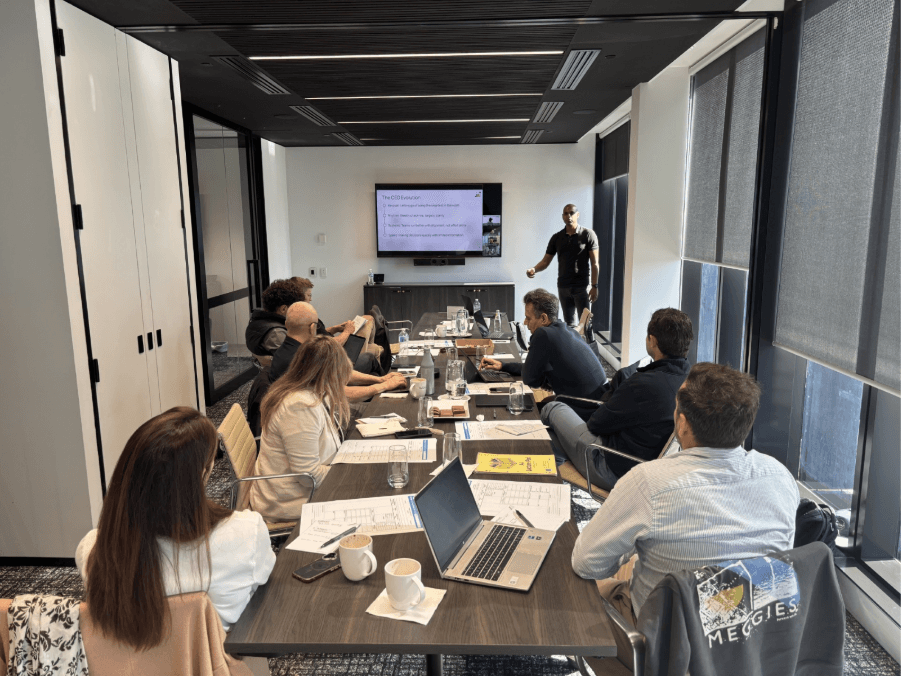
Sessions are shaped around the audience, their workflows and the decisions they need to make—not generic tool demonstrations or abstract AI theory.
Create a clear, practical baseline for leaders, technical teams and operational staff.
Explore opportunities and risks using the organisation’s own workflows and constraints.
Turn the session into prioritised experiments, adoption guardrails and practical next steps.
What Good Looks Like
More confident leadership decisions
A shared language for AI opportunities and risk
Use cases grounded in real work
Clear next steps for responsible adoption
What We Work Through
The work is shaped around your organisation, but the core questions stay practical: where value sits, what must remain human, what the system needs to protect and how success will be judged.
A plain-language view of what current AI can do well, where it fails and why human oversight still matters.
Use cases drawn from the organisation’s real work, ranked by potential value, feasibility, adoption effort and risk.
Privacy, security, accuracy, governance and practical boundaries for how teams should use AI in their context.
Concrete experiments, questions to resolve and ownership for the next stage so the session changes decisions rather than becoming a one-off event.
Applied Experience
Mo Jaimangal brings experience as a robotics software engineer, founder, product leader and AI advisor. Jupiter AI sessions draw on live systems and operating decisions rather than generic demonstrations.
Questions
Yes. The language and examples are designed to make technical capability useful to commercial and operational decision-makers without assuming an engineering background.
Yes. Tailoring the material to the organisation’s work makes the discussion more useful and helps participants leave with relevant opportunities rather than a generic list of AI ideas.
Yes. The format can support boards, leadership teams, operational groups, accelerators, research programs and industry cohorts. The depth and emphasis change with the audience.
Specific tools may be discussed when useful, but the session starts with outcomes, workflows and risk. That prevents the organisation from treating a fast-changing tool choice as the strategy.
Use a free 30-minute review to identify the workflow worth fixing first and the most practical next step.
Book The Free Review